
November Technology Salon: Computers in Schools TCO
For November, we have a very special Technology Salon. In coordination with the World Bank e-Development Thematic Group and infoDev, we will have a World Bank ICT and Education Community of Practice Discussion on Total Cost of Ownership:
How much does it really cost to introduce and sustain computers in schools? A discussion of Total Cost of Ownership (TCO) and models of affordable computing for schools in developing countries.
Come join what we hope to be a lively presentation and discussion of the findings of both activities, their potential implications, and the underlying methodologies and assumptions underpinning the models explored in this work.
Speakers:
- Karen Coppock, VP of Consulting Services, Vital Wave Consulting
- Brendan Smith, Senior Consultant, Vital Wave Consulting
- Jon Camfield, Director of ICT, Youth Service America
Logistics:
11am to 12:30pm – 6 November 2008
The World Bank “J” Building,
701 18th Street, NW, room J-B1-075
While this Technology Salon promises to be larger than usual, seating is still limited, so please Read More
September Technology Salon: USAID ICT4D Challenges

Let’s solve his ICT4D challenges
The Technology Salon returns to Washington DC this September 25th to explore an innovative initiative from USAID: ICT4D Challenges.
Akin to the contests that had Lindbergh cross the Atlantic and Rutan/Branson cross into space, ICT4D challenges (contests, makeovers, and competitions) will leverage user-driven innovation to create ICT-based solutions for major development challenges, with the incentive of cash prizes and possible inclusion in a USAID project. These challenges will spur innovation at the nexus of development and technology while forging new connections between the technology and development communities.
What better forum to explore where USAID is going with these challenges and help shape that path than the Technology Salon, our intimate and informal discussion of technology and development?
Read MoreOmatek Smartbook: Local 4P Computing Innovation
Earlier this month, I had the luxury of inspecting a new Omatek Smartbook at the Ministry of Education in Ghana. The Smartbook is a low-cost laptop aimed at the education market, and with one look, you’l know its an XO laptop derivative:
It also happens to be one of the many
4P Computers that are coming out of the developing world. Not content to leave the 4PC market to Asus, these local computer manufactures are making their own low-cost, highly-portable, power-efficient, and performance-relative computers for local and regional markets.
OLPC News Community of Practice
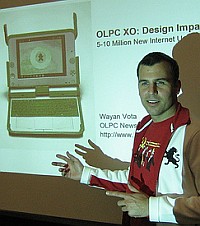
Enlightened by OLPC News success
Recently, I’ve been looking at OLPC News in a whole new light. I’m seeing it as more than just a blog. In fact, when you bring in the OLPC Wiki, I see a three part system that is the community of practice around the One Laptop Per Child program.
First, a definition of a community of practice:
A community of practice is a group of people who share a common passion for a subject and through regular interaction and communication, improve their knowledge and expertise in the topic area. Communities of practice differ from teams and networks in that they are bound by a shared desire to learn, and implement the learning through practice.
I believe that the triumvirate of OLPC News, OLPC News Forum, and OLPC Wiki serve to accomplish four goals typical of a community of practice.
Read MoreFrom OLPC to ASUS: An Overview of 4P Computing
Three years ago, the IT industry was shocked with a radical idea – a “$100 laptop” designed specifically for education in the developing world. Price would be low and yet quality high, through innovative design mixed with low-cost components, and sales would be focused exclusively on the developing world.
This heretical bombast upset the longstanding computer manufacturing tradition to keep adding functions to maintain high prices in the developed world, while ignoring the developing world. While the revolution was lead by One Laptop Per Child and its visionary founder, Nicholas Negroponte, we now have a whole plethora of revolutionaries – from the upstart Asus to the goliath Intel – who are developing 4P Computers.
4P Computing is a new class of appropriate technology – computing power, performance, portability, and price specificity designed for the realities and markets of the developing world.
Now join Wayan Vota, an expert on ICT in the developing world, in an overview of this revolution, the resulting 4PC’s, and their impact on the whole information and communication technology industry:
Read More